Popular on The Blog

Recent Posts

Wednesday, 3 June 2009

Working on The Psoas Muscles Today

The January 2013 version (with functional links and videos) of the below blog post can now be found at: 


Pic. left: Reading Uni Riding Club riders ready for hard work on their Psoas ;) From left to right: Lucy on her own Jack, Claire and Helen on riding centre's horses.

Here is an exercise I mentioned in the post about the Psoas Muscles. I was taught how to teach this several years ago and found it very useful for teaching deep seat and core stability while riding.


Ideally you need an assistant do it well and not to strain the incorrect muscle groups.

First of all I ask the rider to sit as relaxed as possible with their legs loosly dropped from their hips. This allows me to asses the natural tendencies in the rider's body like perching forwards, leaning back, collapsing one way or the other, gripping etc It also gives me a chance to relate the rider's built (like the lenght of the thighs, the proportions of their bodies: upper body to lower body etc) to the horse's conformation, the saddle, the position of stirrup bars etc All those details will influence the rider's position and later the way they influence the horse.

Once I have an idea about the above I ask them to find neutral pelvic position. I don't think there is a text book image of this as everybody is different to the rider has to find its own neutral spinal alignment. I use posterior and anterior pelvic tilt to give the rider an idea about the two extremes (and doing the posterior pelvic tilt introduces them to the driving seat), then find the one in between.
I tell the rider to engage the core by bringing their belly button towards their spine and feeling a muscular engagement in their middle bodies that is similar to the one when you cough or sneeze.
Then we move onto stretching front of thighs gently to be able to take them back and more vertically under the pelvis.
Have a look at the pictures below for Before and After.

Before

Claire's back is hollow, her legs are in front of her centre of gravity and her core muscles are switched off. Her stirrups lenght might be good for jumping but not for effective work on the flat.

After

Claire's lower leg could be a little further forward and her head back and on top of her shoulders but her core muscles are switched on, she has just the natural curve in her spine and her legs are underneath her giving her balance. She also carries herself here rather than relying on the horse to do it for her. As a result she got some very decent work out of the horse today.


Pic. above: Claire is trying it all in practice. She's on an 'up' of rising trot here and notice how balanced she is - it gives the impression that if the horse was taken away from underneath her she would land on her feet. In other words, she is in control of her centre of gravity and allows the horse to trot freely.

Here is how I work on the Iliopsoas muscles: I ask the rider to palpate their hip bone and then slide their fingers to the side of it where they can feel a little dip/shallow shape. They are to keep a couple of fingers there. I then press my hand against their lower leg and ask them to push against my hand outwards with the whole leg starting at the hip. This action moves whole thigh away from the saddle for a moment. Then I help the rider to achieve the same while keeping their legs gently touching the horse's sides.

Sometimes it takes a few goes to do it right but when done correctly the rider can feel a tiny muscle belly popping up underneath their fingers. That tiny muscle engage all of the outer thighs muscles which in turn switch off "the grippers". (Muscles Work In Pairs)

Pic. below from http://www.horsemagazine.com/CLINIC/Fitness/part2/lisa_part2.html shows the rider gripping with inner thighs.Very common mistake and super hard to un-learn!

The secret is to keep those little belly muscles popped, thighs rotated inwards a fraction, inner thighs long and soft and outer thighs engaged. Amazingly this also makes the rider sit upright and strong within their abdominal muscles. It feels as if you were plugging yourself into the horse, gives you stability and helps the horse move freely. It also gives you a feel of making a room for a horse in between your legs by opening in your hips.

The Uni girls worked super hard on this today and I thought they did a great job. Probably the best feedback they got came from their horses that really loosened and became more rideable.

I am looking forward to learn even more about this biomechanics malarkey so I can teach even better and get the best even out of very ordinary horses :)


Share:

The Psoas Muscle - the key to good position and deep seat

The January 2013 version (with functional links and videos) of the below blog post can now be found at:


I've been meaning to write this post for quite some time so finally here it is. I am sure there are some great authorities out there who could explain it all much better and I am by no means an expert. This is just a result of some experiences and lots of digging in the widely available sources.


The first time I was told about psoas/iliopsoas muscles was about 16 years ago while training long distance running as a teenager. The psoas muscles can get really tight in runners so specifically designed stretches were part of our every day training. I had never really thought about them since then until many years later I had a chance to train with a dressage trainer and rider. She was trained by a Centred Riding instructor while working with horses in Germany. It was my first year in the UK and I could barely understand simple words spoken with British accent not to even mention medical vocabulary so our sessions were challenging to say the least ;) What I learned from her though completely changed my riding and the way I teach now. I am still learning how to pass this knowledge on to my riders and how to use it better myself. 

This post is about the Psoas muscles, the muscles that MAKE the rider...

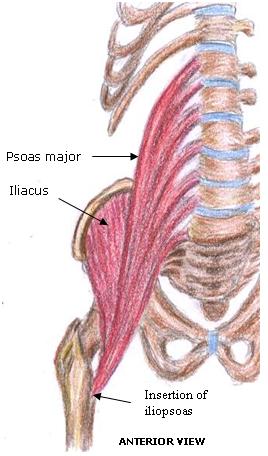
What are Psoas muscles?


"They are located deep in the abdomen, on both sides of the lower spinal vertebrae. We do not think of the psoas muscles because the functions they perform are done in conjunction with one or more of the surface muscles. This is probably the reason the riding world does not look further than the surface muscles at the front and back of the body when determining how riders stabilize themselves on their horses. Out of sight, out of mind.
The psoas muscles are the bridges between the upper body and the legs. They are the only muscles that directly link the spine to the legs. The psoas attach directly from the lower spine to the top of the inner thighs at the lesser trochanter of the femur. They do not attach directly to the pelvis, but influence it through their connection to the iliacus muscles, which are attached to the walls of the inner pelvis.
The psoas muscles flex your thighs at the hip, enabling you to raise your knees, thus lifting your feet off the ground. Since the tendons of the lower part of the iliopsoas attach to the inner thighs,when flexed, they also tone the adductor muscles located on the inside of your thighs."

How and What For do Riders Use the Psoas

The psoas and iliopsoas hold the torso vertical and engage to stop you from falling backwards behind the line of gravity which passes behind the hip joints. The psoas, engaged with the rectus abdominis hold you into the centre of the saddle so that your two seat bones are connected to the horse's back muscles on either side of his spine. This is a vital piece of information, for sliding off one side or the other (usually to the outside through corners) is a major cause of horses falling out through their shoulder or haunches or bulging.

[Source: 
The Psoas Muscles - The Missing Link]

"I began offering bodywork sessions at the local riding center. I realigned and balanced a rider’s body using Zen Bodytherapy® alignment techniques and Zen Triggerpoint Anatomy® work. During these sessions, I asked each person to flatten his or her back against my table. Most of the riders who did this tightened their abdominal muscles when bringing the front of their pelvises up in order to flatten their backs.In the process of working with about twenty riders, two of them did something completely different from the rest. Both were able to flatten their backs while their abdominal muscles fell back and softened. This was something I had seen before, but only in bodies that had completed the series of Zen Bodytherapy® sessions. It indicated to me that these riders were using their psoas (used for both singular and plural) muscles to flatten their lower backs. I asked both riders where they had learned to do this, and both said it had been while riding bucking horses when they were young. I considered these riders to be expert horsemen and both were using their psoas muscles to adjust the position of their lower backs!
I later had the opportunity to ask an expert rider if he used his psoas muscles when riding. Although he had not previously heard of the psoas, when I showed him a model of the spine and the psoas muscles, he said they were in fact the muscles he used. He went on to explain he used these muscles to distribute his weight over the horse’s back and this was important in enabling his horses to jump correctly. This confirmed my theory that accomplished riders were using their psoas muscles to stabilize themselves on their horses." 

Working the Psoas/Iliopsoas

One of the very simple yet very effective exercises I was shown is done while sitting in the saddle. You need an assistant to do this without too much muscle strain. I will describe the exercise fully in the post below (direct link to it: Working The Psoas Today).

For now have a look at this video. Not only does it explain well about the function of the Psoas Muscles but also shows some exercises that are similar to what I was taught when I was running and which are very useful for riders:


More links of interest: 

Important Riding Muscles:
Share:
© Riding Instructor's Diary | All rights reserved.
Blogger Template by pipdig